
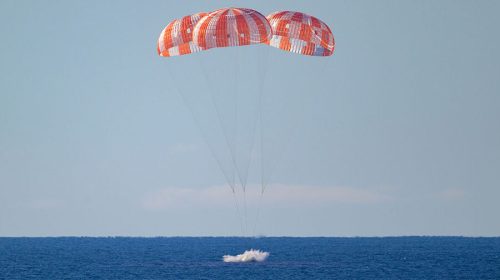






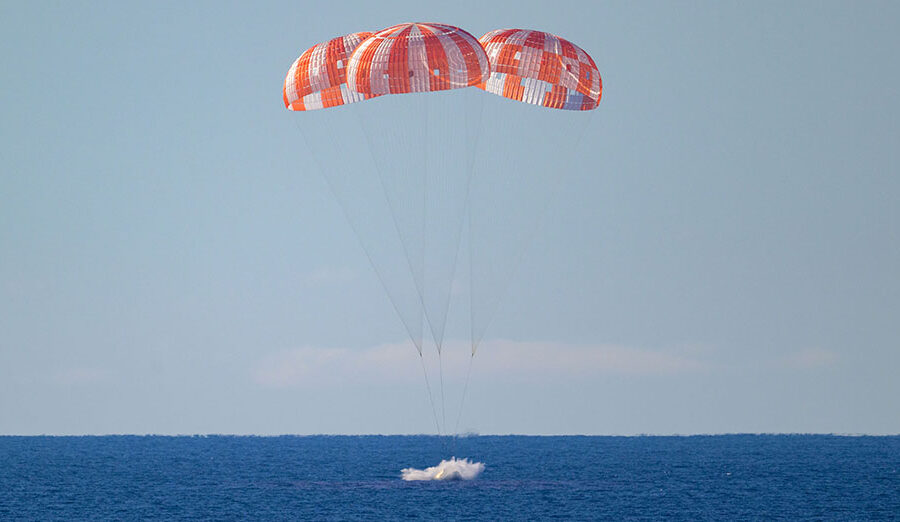
10 March, KATHMANDU: The historic Artemis II mission, which brought humans back to the moon after half a century, concluded with a successful splashdown in the Pacific Ocean on Friday. Surviving a highly risky reentry, the astronauts not only made a safe landing, but also paved the way for a new chapter in human exploration.
The nearly 10-day mission observed rare astronomical scenes from the far side of the Moon. A total solar eclipse, a stunning alignment of planets, and glimpses of Earth in the vast void of space made the journey not only scientifically, but also emotionally historic.
Returning from their mission, Commander Reed Wiseman, Pilot Victor Glover, Christina Koch and Canadian Jeremy Hansen emerged from their capsule, which landed in the ocean near San Diego, with both excitement and relief. Military helicopters rescued them one by one and took them to the US Navy ship USS John P. Murtagh.
NASA Administrator Jared Isaacman described the team as “representatives of humanity” and said their contributions laid the groundwork for future lunar landings. NASA’s mission control was also in a celebratory mood following the successful landing. Officials described it as “the beginning of a new moonshot.”
The Orion capsule, Integrity, was traveling at 33 times the speed of sound as it entered Earth’s atmosphere. During reentry, the capsule was enveloped in a red-hot plasma, temporarily disrupting communications. This was considered the most critical phase of the mission, as the safety of the entire crew depended on the success of the heat shield.
Both family members and scientists were relieved when the capsule regained contact after a six-minute blackout. The capsule eventually landed safely in the ocean, slowing to about 24,000 miles per hour.
The campaign also conveyed a message of diversity and inclusion. Christina Koch became the first woman to fly to the moon, while Victor Glover made history as the first black astronaut and Jeremy Hansen as the first non-American. They shared their experiences and expressed emotional moments.
The mission, which launched from Florida on April 1, set a new record by traveling the furthest distance ever traveled by humans without orbiting the moon—406,771 kilometers. During the mission, the astronauts captured images of the far side of the moon that the human eye had never seen before.
There were some technical issues during the journey. There were problems with the drinking water system, a valve that controls the fuel flow, and a problem with the toilet, but the team said they managed those challenges successfully. Further testing of the capsule’s thermal shield is planned after reentry.
According to NASA, the mission was a test flight for the upcoming lunar landing plan. The revised program calls for an orbital maneuver through Artemis III, followed by a human landing on the moon’s south pole in 2028 under Artemis IV.
Astronaut Wiseman urged that the mission be seen not just as a technological achievement but as an opportunity to unite humanity. He expressed his belief that the journey would inspire everyone towards a shared future, highlighting the need to remember the beauty of Earth and its unique place in the universe.














+ There are no comments
Add yours