







Gokarna Dayal, Baitadi
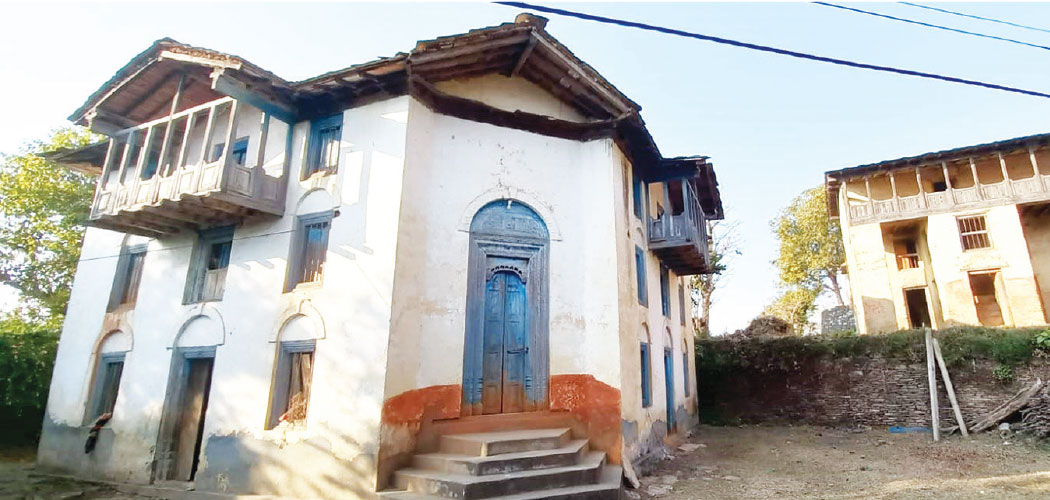
03 October, BAITADI: The traditional houses in Pallachaudali village of Dasharathchand Municipality, with intricately carved wooden doors and stone-slate roofs, now stand faded as if narrating tales of a bygone era.
Rusted locks hang from the doors, while nettles and invasive shrubs have overgrown the courtyards. Elderly people sit at the village rest stops with forlorn eyes, waiting for their children who have moved to the Tarai or grandchildren who have gone abroad in search of opportunities. This is the bitter reality of Baitadi’s rapidly emptying villages.
Places such as Dehimandau, Shahilek and Dewalhat, once bustling with people and activity, have now fallen into an eerie silence. Over the past decade, major national pride projects worth billions of rupees, including the Mid-Hill Highway and Mahakali Corridor, have reached Baitadi. Motorable roads have been opened in all 84 wards of the district. Ironically, however, the vehicles travelling on these roads often have no passengers.
As people have moved to the Tarai and urban centres in search of jobs and opportunities, villages and market areas have become deserted.
Student numbers fall by 60 per cent in five years
The depopulation of villages has directly affected educational institutions. According to Dr. Surendra Bam, a professor at Jagannath Multiple Campus, only 240 students now study at the campus, down from 600 five years ago. There are currently no students studying mathematics at the campus.
Six schools in the district headquarters, Dasharathchand Municipality, have been merged with other schools due to a shortage of students. According to Pushkar Raj Sharma, information officer at the Education Development and Coordination Unit in Baitadi, 114 basic-level schools across the district are at risk of closure or merger.
Technical and higher education institutions are also struggling to attract students. Gokuleshwar Agriculture Campus in Dilashaini, Bhimdatta Technical Institute in Patan and Birendra Secondary School in Shahilek are finding it difficult to fill their allocated quotas.
New town, airport projects stranded
It has been more than a decade since an ambitious plan was introduced to develop Patan of Baitadi as one of the country’s 10 model cities, with a target population of 100,000. Roads, a modern bus park and parks have been built at a cost of tens of millions of rupees, but there are few people or vehicles to be seen there.
According to Jhanka Thapa, chief of the Intensive Urban Development and Building Construction Project Office, the project could not progress as planned because land pooling could not be carried out for 10 years.
Likewise, no aircraft has landed at Baitadi Airport in Patan since March 2020, despite Rs 180 million being spent on its construction. The runway has now become a popular spot for making TikTok videos. Patan Municipality Mayor Gauri Singh Rawal said the airport could not be brought into regular operation due to high airfares and the lack of regular flights.
According to Khangendra Singh Dhami, chief of the District Coordination Committee, even bus services from Baitadi to Kathmandu have been discontinued due to a lack of passengers.
Political clout declining, farmland lying fallow
Migration has also eroded Baitadi’s political representation and influence. According to the 2011 census, the district had a population of 250,898, which fell to around 242,000 in the 2021 census.
Baitadi had three constituencies during the Panchayat era and two after the restoration of democracy, but now has only one federal constituency.
Dasharathchand Municipality has lost nearly 10,000 people over the past decade. In the last five years alone, 483 families have obtained migration certificates from the municipality.
As a result, 75,104 ropanis of fertile farmland in dozens of villages, including Devalhat, Pallachaudali and Baskot, have been left fallow and covered with shrubs, according to Deepak Karki, chief of the municipality’s agriculture section.
Imbalanced development
Rural development expert Dr Kedar Chandra Bhatta said the situation had emerged because Nepal lacked clear laws governing development and migration. He said an imbalance had been created by considering it development to concentrate budgets on projects in the hills while encouraging people to acquire residential plots in the Tarai.
According to Bhatta, migration from the hills could have been curbed to some extent if the provincial capital of Sudurpaschim had been established in the hills rather than in the Tarai.
Rapid migration from the hills has also turned the fertile plains of Kailali and Kanchanpur in the Tarai into concrete jungles.
Tourism entrepreneur and social activist Mayaprakash Bhatta called for the provincial government to introduce policies such as ‘Go to the Hills’ to retain the hill population.
He said the exodus could be checked only by creating employment opportunities in villages, providing skills-based technical education, promoting commercial farming and fruit cultivation suited to local geography, and expanding tourism.










+ There are no comments
Add yours