







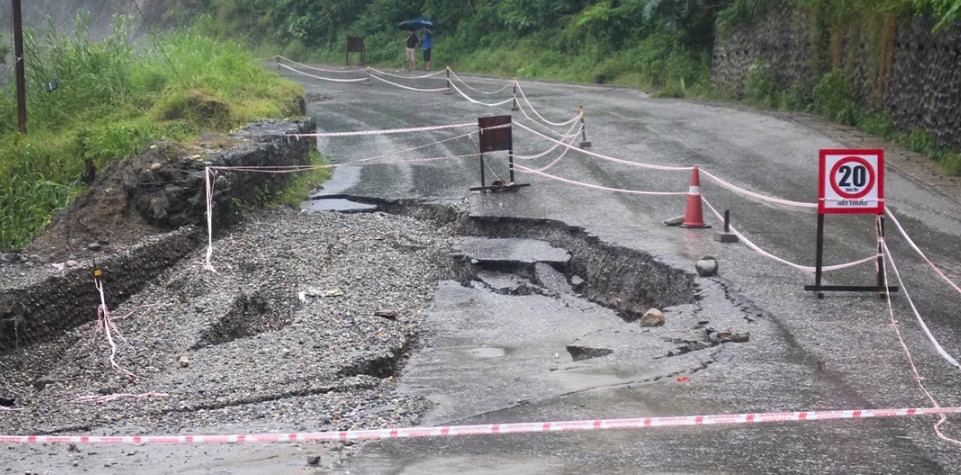
26 September, KATHMANDU: All major highways connecting the Kathmandu Valley to other parts of the country are completely blocked due to floods and landslides following continuous rain. Currently, only the ‘Tribhuvan Rajpath’ is operational as an alternative to enter the valley, but the traffic has increased there as well.
The natural disaster has put the valley in a state of ‘blockade’, and its biggest impact is expected to be on the daily supply chain.
Considering the risk of continuous rain and floods-landslides, the administration has banned the operation of long-distance vehicles except for essential ones. Therefore, hundreds of cargo and passenger vehicles are currently lined up on the roads of Kathmandu. Similarly, thousands of passengers are stranded due to road blockades caused by floods-landslides, and the fear of inflation and scarcity has increased in the market due to the severe impact on the supply chain.
Where are the roads blocked?
As the landslides and road collapses continue, the administration has banned vehicular movement on the main highways indefinitely. The road connecting Kathmandu, specifically the Muglin-Narayangadh section of the Prithvi Highway, is completely blocked at 5 locations in the Dhading section.
Landslides with rocks have occurred at Krishnabhir, Tigradkhani, Jamireghat, and Jwankhola in Benighat Rorang, and at Parewa Bhir in Gajuri. According to the Nagdhunga-Muglin road project, although the gabion wall at the lower part of the road at Krishnabhir has fallen, the main track is safe, but landslides elsewhere make it impossible to reach there.
According to the District Administration Office, Dhading, roads are blocked at Krishnabhir, Benighat Rorang-7, Tigradkhani, Benighat Rorang-10, Jamireghat, Benighat Rorang-9, Parewa Bhir in Gajuri Rural Municipality-2, and Jwankhola, Benighat Rorang-10.
The road at Krishnabhir is closed in both directions due to landslides with rocks falling from above. Although efforts are underway to clear the debris, the work has been halted as rocks continue to fall, according to the administration. Roads at Tigradkhani and Jamireghat are also blocked in both directions due to landslides with rocks. Efforts are being made to clear the roads at both locations. The road at Parewa Bhir in Gajuri Rural Municipality-2 is blocked in one direction due to landslides with trees. Efforts are underway to remove the obstruction there. Similarly, the road at Jwankhola, Benighat Rorang-10, is blocked in one direction due to landslides with rocks. Efforts are also underway to clear the debris at this location.
As continuous rain is occurring in Dhading and there is a possibility of heavy rainfall, the administration has urged people to travel only after considering the road conditions and risks. The administration has requested the general public to avoid long-distance travel except for essential purposes and to exercise caution.
Similarly, the road has subsided at Ichhakamana-4, Dharapani in Chitwan, and according to the Road Division Bharatpur, the road opened during the day on the Muglin-Narayangadh section has been closed again until further notice for safety reasons. Traffic is also affected by landslides at various places along the Muglin-Pokhara section in Tanahu.
BP Highway and Kanti Lokpath also blocked
The BP Highway, connecting eastern Nepal with Kathmandu, and the Kanti Lokpath, connecting Kathmandu with Hetauda, are completely blocked. Landslides have blocked the road at Bhirkhedhara in Godawari, Lalitpur, Pangurdol, Takurche, and Chapeli along the Kanti Lokpath. Although the Minister of Physical Infrastructure and Transport, Sunil Lamsal, claimed that the landslides would be cleared within two hours of the rain stopping, the continuous drizzle has hampered the work.
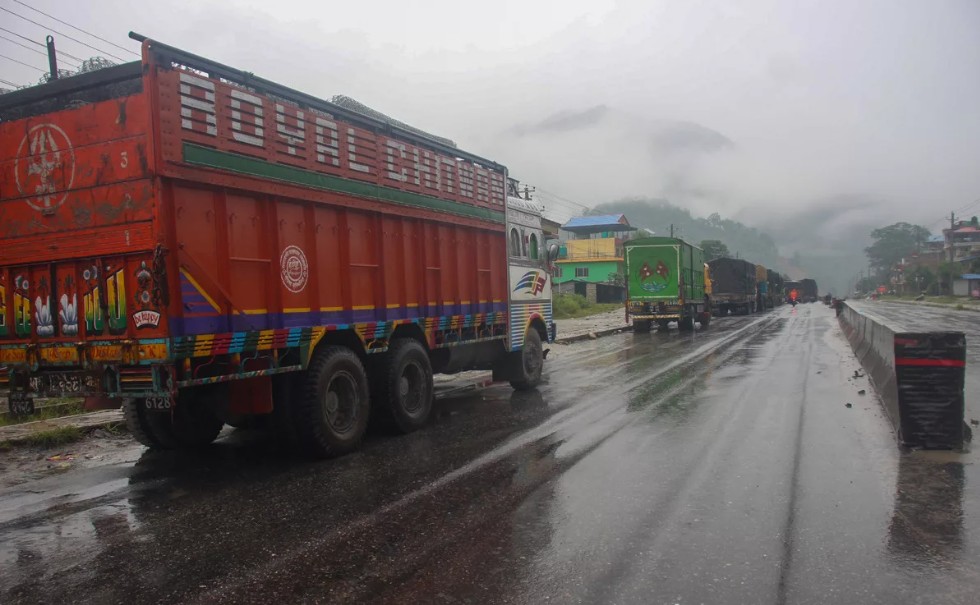
Similarly, the BP Highway, the main lifeline connecting the eastern districts of Nepal with Kathmandu, is blocked due to landslides at Charasaybesi and Gimdibesi in Roshi Rural Municipality, Kavre. The Roshi River has crossed the warning level, increasing the risk in the riparian areas, and the administration has completely banned vehicular movement on this highway.
Struggle on alternative routes, heavy vehicles stopped on Tribhuvan Rajpath
Considering the potential risks, vehicles leaving the Kathmandu Valley have been stopped at Nagdhunga since 8 PM on Thursday. The Valley Traffic Police is diverting small vehicles leaving Kathmandu via the Southkali-Phakel road section and via Tokha-Chahare towards Nuwakot, but the Southkali-Sisneri road is blocked by rain. Vehicles operating via Tribhuvan Rajpath from Palung, Makwanpur to enter Kathmandu have been made one-way, causing a long traffic jam there.
Similarly, a timetable has been implemented for vehicular movement on the Tribhuvan Rajpath, and the operation of heavy vehicles has been prohibited. The District Administration Office, Makwanpur, has determined a specific timetable for vehicular movement on the Tribhuvan Rajpath under a rotational system. Due to the obstruction of the Mahendra and Prithvi Highways and the excessive traffic pressure on the Tribhuvan Rajpath, separate times have been set for vehicles traveling from Hetauda to Kathmandu and from Kathmandu to Hetauda to ease traffic management.
According to the administration, the time for vehicles traveling from Hetauda to Kathmandu (departing from Chauki Tol) has been set from 10 AM to 2 PM on Friday, Ashoj 9. Vehicles can operate from 4 AM to 8 AM and from 10 PM to 2 AM on Saturday, Ashoj 10, until Sunday, Ashoj 11.
Similarly, for vehicles coming from Kathmandu to Hetauda (departing from Simbhanjyang Chowki), the time has been set from 7 PM to 11 PM on Friday, Ashoj 9, from 1 PM to 5 PM on Saturday, Ashoj 10, and from 7 AM to 11 AM on Sunday, Ashoj 11.
Considering the road conditions and the risk of traffic jams, the administration has also banned the operation of heavy cargo vehicles. Until further notice, the operation of heavy cargo vehicles, except those carrying fuel and LP gas, is completely prohibited. The administration has stated that all heavy cargo vehicles longer than 10 wheels and weighing more than 15 tons are prohibited from operating on that section of the road.
For passenger buses, only buses with a maximum length of 11 meters are permitted to operate.
Where else are roads blocked across the country?
In Lumbini Province, traffic is completely blocked along the Butwal-Palpa road section near Siddhababa Temple due to landslides. The road between Charchare and Joradhara in Tinau-5, Palpa, is also blocked by landslides. Similarly, the Kaligandaki Corridor (Rawase and Patikhola) in Gulmi and the Ghhorahi-Thawang Shahid Marg (Byangkhola) in Rolpa are completely blocked.
In Koshi Province, about 15 meters of the road at Bhandare Khola in Manebhanjyang on the Okhaldhunga-Siddhicharan Lokmarg has been washed away by mudslides and floods, completely halting traffic. Similarly, the Chatara-Barahachhetra road in Sunsari is also blocked by landslides.
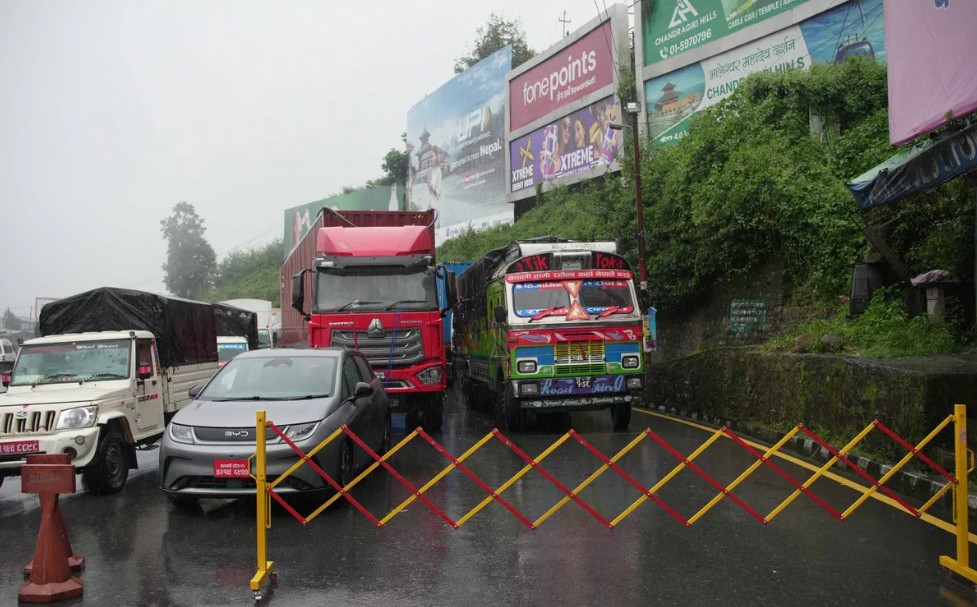
In addition, the Pasang Lhamu Highway, Mailung-Syabrubesi road, and Kalupande Highway in Bagmati Province are also blocked due to floods and landslides.
What is the department doing to clear the roads?
Considering the rain and disaster, the department has implemented a special action plan to carry out immediate rescue and repair work in case of road blockades.
According to the department, more than 240 heavy machines are on standby in various sensitive and risky sections across the country. The policy is to dispatch equipment within half an hour and clear the road within a maximum of two hours if a landslide occurs and blocks the road, but the Road Department has stated that it has not been able to clear the blocked roads due to the continuous rain.
To ensure that there is no shortage of fuel for operating the machines, diesel and necessary fuel sufficient for at least 48 hours (two days) have been sent to the field in drums along with the machines. In addition, engineers, sub-engineers, supervisors, and machine operators have been deployed in the field 24 hours a day, the department said. The department also stated that a legal and technical mechanism has been prepared to immediately rent heavy equipment from the private sector if government resources are insufficient.









+ There are no comments
Add yours